Six-Pack Souvenirs: Why the Coolest Thing at the Show Isn't a Shirt Anymore
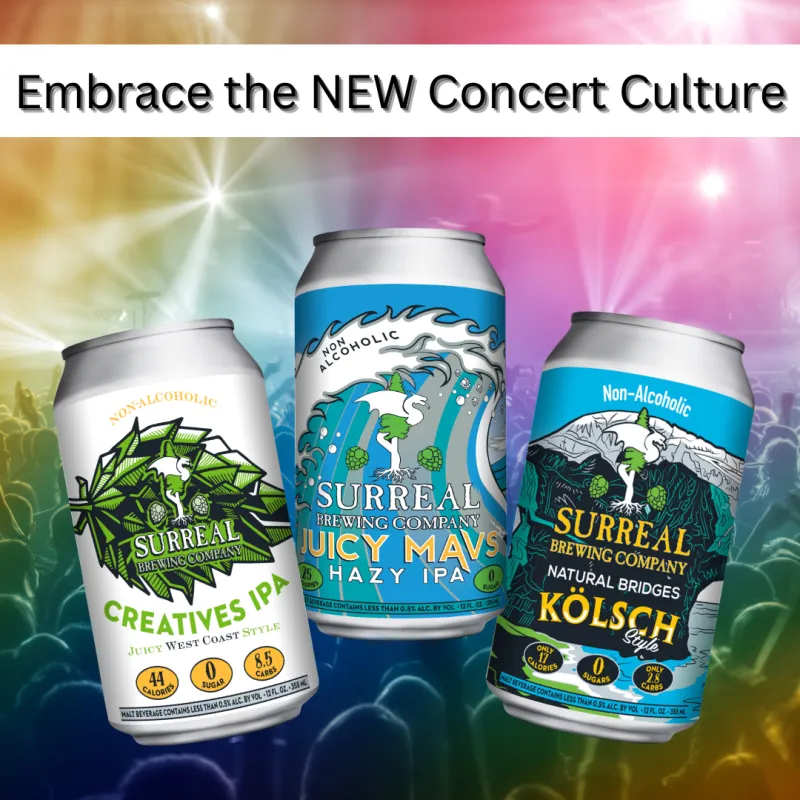
Photo: merch table beer cans indie concert venue, via surrealbrewing.com
There's a moment happening at venues from Portland to Philadelphia that would've been unthinkable a decade ago. The line at the merch table — the one that used to shuffle past a folding table of shirt sizes and a cardboard box of vinyl — now stops at a small mini-fridge humming next to the tote bags. Inside: tallboys and six-packs with the band's name screenprinted where the logo usually goes.
And here's the part that has tour managers doing double takes: the beer is often the best-seller in the building.
The Fridge Changes Everything
"I ran merch for a mid-tier indie act for three years," says Dana, a tour manager who asked to use a first name only. "Our hoodie was $45. Our LP was $30. The collab cans we started doing last spring were $12, or $15 with a collapsible six-pack carrier. By the second week of tour, the carrier was gone by doors. Gone. People were buying the carrier as the souvenir and giving the beer to whoever was standing next to them."
The logic, once you hear it, is hard to argue with. A hoodie lives in a drawer. A record lives on a shelf — beautiful, but static. A beer is consumed, shared, photographed, and in the case of the can itself, often kept. Fans are taping empty cans to their walls the way an earlier generation taped ticket stubs.
There's also the price psychology. At a moment when $40 for a tour tee feels like a small mortgage, a $12 can reads as an accessible way to support the band. You came with $20? You can still leave with merch. That's a door that price creep had quietly closed.
Why Bands Are Saying Yes
The co-branded beer deal isn't new — arena acts have licensed their names to breweries for years. What's new is the scale. Small breweries, the kind with a 15-barrel system and a taproom off a frontage road, can now turn around a short run of custom-labeled cans in weeks at a cost that makes sense for a band playing 400-cap rooms.
"A local brewery gets to put a band everyone in town loves on their can, and suddenly their taproom has a line," explains one Midwest venue booker. "The band gets a product that's cheaper than printing shirts and doesn't require size exchanges. The venue gets a reason for people to buy drinks instead of sneaking in flasks. Everybody's problem gets solved by the same fridge."
Some acts have gotten savvier still, treating the can like a collectible rather than a beverage. Limited runs per city. Different label art for each market. One Brooklyn band we heard about pressed a different variant for each night of a three-show run, and the completists came all three nights.
What the Fans Say
Outside a sold-out show in Chicago, the merch line wrapped around half the lobby, and the fridge at the front of it was doing brisk business. The fans we talked to kept landing on the same themes.
"I already own six hoodies from bands. I don't need a seventh," said one concertgoer in her late twenties, holding a four-pack with a screen-printed illustration from the night's headliner. "But this? I'm bringing this to my friend's BBQ on Saturday and it's going to start a conversation. That's worth more to me than another hoodie."
Another fan put it even more simply: "A shirt says I was a fan. A beer says here, be a fan too."
That shareability is the whole engine. Beer merch travels. It gets handed to friends, brought to parties, cracked open on porches while someone puts the band on the speaker. It's the only piece of merch that markets itself after the show ends.
The Fine Print
None of this is without friction. Alcohol sales at merch tables live in a regulatory maze that varies state by state — some venues require the beer to be sold through the bar with a ticket system, others allow direct sales with a licensed vendor on site. Tour managers describe a patchwork of rules that changes every time the van crosses a state line.
There's also the optics question. Indie music has had a long, complicated relationship with booze branding, and some artists flatly refuse to do it. The bands leaning in tend to frame it as collaboration rather than endorsement — a hometown brewery, a shared audience, a product they'd drink anyway.
And the practical stuff matters: cans are heavy, they're cold-chain sensitive, and a merch person who signed up to fold shirts is now also managing inventory that melts. The good ones have adapted. The fridge, it turns out, is a skill.
The New Souvenir Economy
Step back and the trend reads less like a gimmick and more like a correction. Merch was never really about the object — it was about proof. Proof you were there, proof you were early, proof you belong to something. The beer can just happens to be a cheaper, lighter, more social form of proof than anything else on the table.
So if you walk into your next show and see a mini-fridge glowing next to the vinyl crates, don't be surprised when the line for it is longer than the one for the hoodies. Grab a can, keep the carrier, and know that somewhere a tour manager is doing the math and smiling.
The merch table has a fridge now. Honestly, it was only a matter of time.