Fermentation on the Ones and Twos: Inside the Taprooms Run by Working DJs
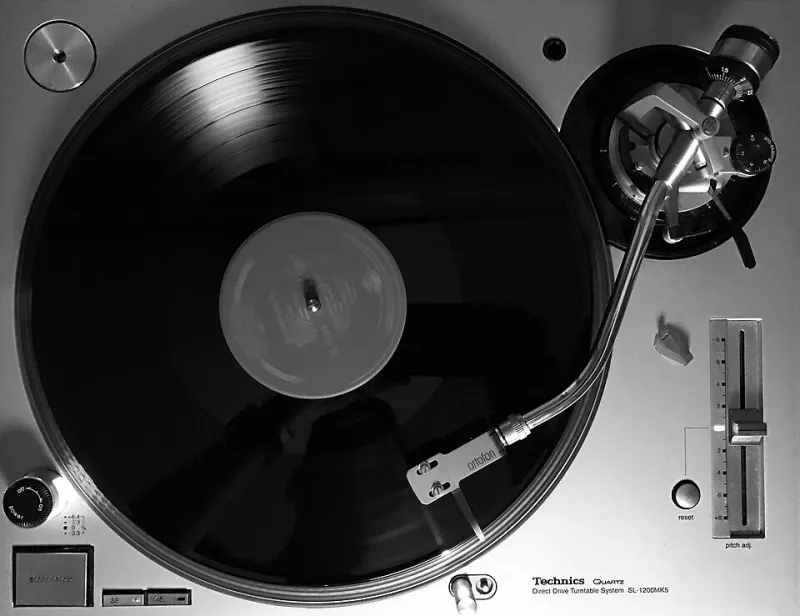
Photo: Unknown authorUnknown author, CC0, via Wikimedia Commons
There's a moment — usually around 6 p.m. on a Friday — when the taproom at Slow Bloom Brewing in East Austin shifts. The lights drop a shade warmer, the crowd murmurs a little lower, and Marcus Delgado ducks under the bar, pulls a record sleeve from a crate wedged next to the keg couplers, and drops the needle on a dusty Cuban boogaloo 45.
Delgado, 38, has been spinning records since he was nineteen. He's been brewing professionally for eleven years. At Slow Bloom, the two jobs share the same square footage, and if you ask him, they share a brain.
"A recipe and a set list are the same document," he says, pulling a pint of his hazy pale ale, Low End Theory Juice. "You're building tension, you're resolving it, you're deciding when the next thing hits. The beer just ferments slower than the mix."
He's not alone. Across the country, a small but noticeable cohort of craft brewers are also working DJs and serious vinyl collectors — and their musical obsessions are showing up in the glass.
The Playlist as Recipe Card
The connection between music and brewing isn't just vibes. Several of the brewers we spoke with describe their process in explicitly musical terms — layering malt the way you'd layer drums, treating hops like a lead vocal that needs room to breathe.
In Portland, Oregon, Renée Okafor runs a one-barrel nano-brewery out of a garage in the Montavilla neighborhood, where her record collection takes up roughly as much square footage as her fermentation chamber. Her best-known beer, a crisp Kolsch-style ale called Breakbeat Blonde, was designed while she was preparing for an all-vinyl jungle set.
"I wanted something you could drink fast but that had a little snap at the end," Okafor explains. "Like a breakbeat. Clean, then a little rupture. That's the hop schedule. It's literally mapped to a drum pattern."
That might sound like marketing speak, but Okafor has receipts. She brewed a test batch while listening exclusively to ambient records and another to drum-and-bass, then blind-poured them for her tasting panel. Panelists described the jungle beer as "sharper" and "more angular." The ambient batch, she says, "tasted like a nap."
Austin: The House Head Who Brews Saison
Back in Texas, Delgado's musical roots are in house music — long, patient, groove-driven stuff — and his flagship saison reflects it. Fermented warm with a funky Belgian yeast, Warehouse Set spends extra time in the tank, developing layers that reveal themselves slowly over the course of a pint.
"House is a ten-minute song where nothing 'happens' and everything happens," he says. "I wanted a beer with that same patience. No gimmicks, no pastry-collab nonsense. Just a slow build."
Delgado still plays out two or three nights a month at Austin spots like Kingdom and the Electric Church, and he's started doing something unusual: brewing a small batch specifically for each gig, then tapping it at the venue. The beer becomes a souvenir of the night — and the night becomes an ad for the taproom.
"People come up to me at the club like, 'Wait, you're the beer guy?'" he laughs. "Then they show up at the brewery on Sunday asking what I'm playing. It's the same people. It was always the same people."
The Question Everyone Asks: Can You Taste the Bassline?
Skeptics exist, obviously. Dr. Hannah Wexler, a food scientist at a West Coast sensory lab who studies cross-modal perception, is careful not to overpromise. "Context absolutely shapes flavor perception — that's robust science," she says. "Whether the tempo of the music in the brewhouse chemically alters the beer is a much harder claim. But expectation is a flavor ingredient, and these brewers are expert chefs of expectation."
Okafor doesn't argue the science. "Maybe it's a placebo. Cool," she shrugs, mid-crate-dig. "Placebo tastes great with a good record."
What's undeniable is the community these brewers are building. Slow Bloom hosts a monthly all-vinyl night where bottles of Delgado's one-off brews are priced like cover charges — cheap, cheerful, gone by midnight. Okafor pairs garage-sale record hauls with limited pours every second Saturday.
In an industry chasing novelty — milkshake IPAs, cereal mash lagers, collabs with breakfast cartoons — there's something quietly radical about a beer that arrives with a tracklist.
Delgado puts it best as he flips a sleeve under the taproom's amber light: "The record ends, the glass empties. Both of them are about time. I just got lucky enough to sell both kinds."
His next release, he says, drops the same weekend as his next set. No cover. No cover art. Just the brewer, the DJ, and a room full of people who showed up for both.