Shhh Is the New Louder: Inside the Whisper Bar Movement
Photo: Federal Bureau of Investigation, Public domain, via Wikimedia Commons
There's a moment, about twenty minutes into a night out, when everyone knows it. You've leaned in for the fourth time to catch what your friend just said. You've nodded along to a sentence you absolutely did not hear. You've mouthed the words "what?" with the practiced exhaustion of a long-haul flight attendant.
A growing number of American drinkers have decided they're done pretending.
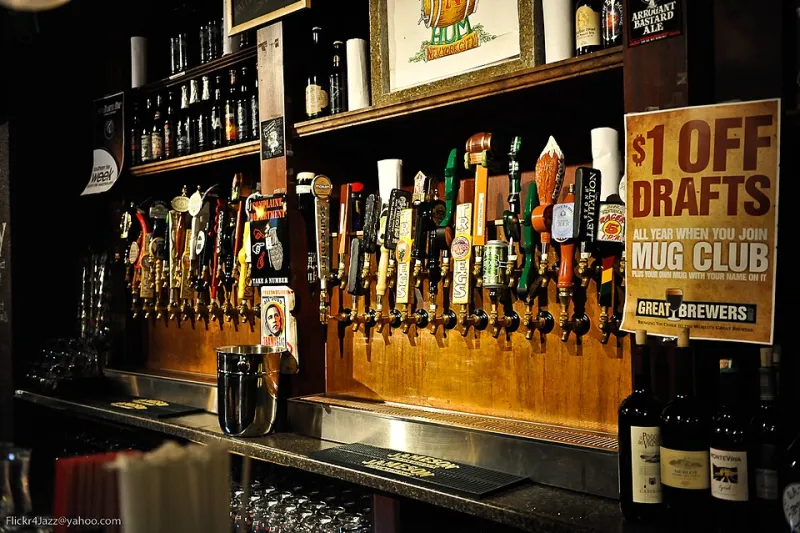
Welcome to the whisper bar — the soundproofed, headphone-free lounge where the decibel meter is the enemy and conversation is the headliner. What started as a pandemic-era daydream (remember when hearing a friend's voice felt like an event?) has hardened into one of nightlife's most counterintuitive business plays: charge more, play it quieter.
The Room That Says No
The physical tell is acoustic paneling — soft, fabric-wrapped, often hidden behind artful shelving. The behavioral tell is simpler: nobody's shouting.
In Chicago's West Loop, Mara Ellison opened her 40-seat listening-adjacent lounge with one non-negotiable. "I told my contractor, I want a room where a first date at table six can't hear table eight's drama," she says. "He thought I was insane. Now other bar owners come by and just... stand in the room. They touch the ceiling."
Ellison's trick is old-school: staggered seating, upholstered everything, and a strict no-DJ-after-9pm policy. Her beer list reads like a curated setlist — approachable openers, something with texture mid-set, a clean finisher. No triple IPAs screaming over the conversation.
"You can't pour a 12% barrel-aged monster in here," she laughs. "It's like booking death metal for a dinner party."
The Economics of Ears
Here's the part that should make every bar owner lean in: people pay for quiet.
In New York, where real estate punishes anyone attempting extra square footage for acoustic treatment, whisper bars routinely command $11–$14 pours for lagers that would cost seven bucks at the dive down the block. Regulars don't blink. They're not buying beer, they're buying bandwidth — the rare ability to have an actual two-hour conversation without vocal cord damage.
"Post-2020, people realized how much they missed just... talking," says Dev Okafor, who runs a small lounge in the Lower East Side. "We went through this whole phase where nightlife was about the spectacle, the bottle service, the visuals. Now the flex is: I went somewhere and I heard everything my friend said. That's the luxury."
Okafor caps his room at 55 people. "Every body adds decibels," he explains. "Scarcity isn't just a pricing strategy. It's acoustics."
Enter the Conversation Lager
Breweries, never ones to miss a vibe shift, have started designing specifically for these spaces. The brief sounds like a contradiction: a beer with enough character to be interesting, but clean enough not to demand your full attention.
In Austin, a mid-size brewery has begun releasing what they're internally calling "conversation lagers" — lower-carbonation, softly bitter pilsners and helles styles brewed to sip slowly over long talks. "Big bitterness fatigues your palate, and honestly it fatigues the conversation," says the brewery's head brewer. "You want a beer that recedes. It's the sonic equivalent of a warm room tone."
The parallel to music is hard to miss. These beers are mixed like a good backing track — present, supportive, never upstaging the vocal.
Not Anti-Music, Pro-Choice
Nobody in the whisper bar world wants to kill the club. This isn't a war on volume; it's a zoning of it.
"There's a night for a 120-decibel basement show and a night for a helles and a real conversation," says Ellison. "The smart bars are figuring out which night they are. The dumb ones are trying to be both at 10pm on a Friday."
The trend's American signature is its pragmatism. In Europe, the hushed beer hall is tradition. Here, it's innovation — a premium rebrand of the simple act of hearing someone. And like most things American nightlife does well, it comes with a wink: the quietest rooms in town are booking up fastest, reservations snapped up by drinkers who've spent a decade lip-reading over house music.
So the next time you walk past a bar with no music leaking out the door, don't assume it's dead inside. It might be the loudest thing happening in nightlife right now. It's just happening at a volume you can finally hear.