Reading the Room Before the Room Exists: America's Door Staff on the Science of the First Impression
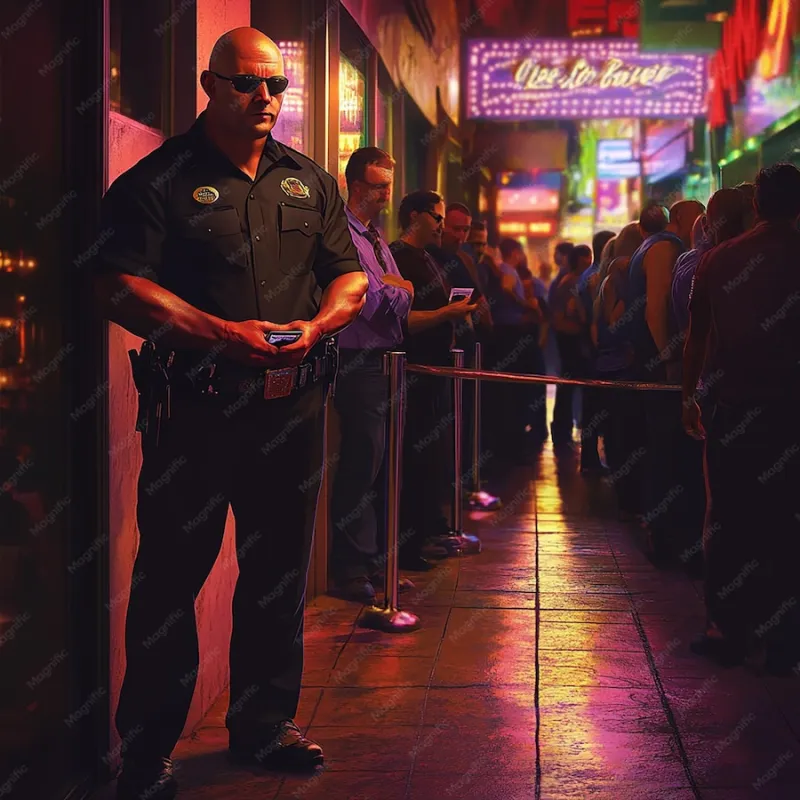
Photo: bouncer at music venue entrance checking IDs at night neon lights, via img.freepik.com
The band hasn't loaded in yet. The taps are still cold from the night before. And Marcus — six years on the door at a 400-cap room in Chicago's Logan Square — has already made about forty decisions that will shape the next six hours.
"People think the door is a checkpoint," he told me, leaning against the stanchion an hour before doors. "It's not. It's the thermostat. I set the temperature of this room before anyone walks in."
The First Ten Seconds
Every door person has a version of the same theory: you can learn almost everything about a group by how they approach the entrance. Are they bunched up and loud, already halfway to a good time? Are they trailing each other, phones out, still deciding whether this is the night they committed to? Did someone in the group get talked into this?
"The bachelorette party of eight moving as one unit? That's energy I can work with," says Dana, who runs the door at a Nashville honky-tonk adjacent to the Broadway chaos. "The group where one guy is clearly dragging his feet — that's the one I watch all night. Not because he's a problem. Because he's the weather system. If he turns, the whole front turns."
This is the unspoken craft: door staff aren't screening for fake IDs so much as forecasting behavior. Veteran door people talk about crowds the way sailors talk about weather — fronts, pressure, the feel of the air.
The Quiet Handshake With the Bar
Here's something almost nobody outside the industry knows: the best door staff and the best bartenders are in constant, wordless communication.
At a mid-size venue in Portland, the door lead texts the head bartender a single emoji when a particular kind of crowd starts building — the eager, early-arriving type that drinks fast because they're nervous. That heads-up means the bar slows the pacing: longer conversations at the tap, water offered proactively, the beer menu talked up instead of the shots.
"A good night is a paced night," the bartender explained. "If the first hour is a sprint, the last hour is a mess. My job and the door's job are the same job. We're just working different ends of the pipeline."
The lager-on-the-festival-grounds wisdom applies here: nobody wants anything too weird at hour one, and nobody wants to be overserved by hour four. The door staff are the ones who can see the whole arc coming, because they've watched a thousand nights follow the same curve.
Part Psychologist, Part Sommelier of Chaos
Ask door veterans what the job actually is and you'll get surprisingly similar answers across cities. It's reading. Constant, rapid-fire reading.
"I've talked more people out of bad nights than out of the venue," Marcus laughs. "Guy shows up already heated about something that happened in the parking lot. You don't escalate. You hand him a compliment, a direction, a destination — 'bar's to the left, band's on at nine.' You give him a script and he follows it. Ninety percent of de-escalation is just giving people something to do."
Dana puts it another way: "I'm a sommelier of chaos. I know which vintage of rowdy this crowd is. There's celebratory rowdy, there's grieving rowdy, there's Friday-after-a-rough-week rowdy. They all need different handling."
The best ones develop an almost eerie accuracy. They know which nights need a firmer hand and which nights they can essentially vanish and let the room run itself. They know that a sold-out indie show behaves differently than a hip-hop night, which behaves differently than the tribute band crowd that's been coming since the nineties.
Why It Matters to Your Night
Here's the thing most concertgoers never consider: the door person is the first artist of the evening. Their tone sets yours. A warm, funny person at the entrance primes a warm, funny room. A power-trip encounter at the stanchion can sour a crowd before the opener plugs in.
So the next time you're headed to a show — craft beer in hand at the pregame, tickets pulled up on your phone — remember that the person scanning them has already done an hour of emotional labor on your behalf. They've calibrated the room, briefed the bar, and mapped the exits, all before the first note.
Tip the door if you can. Say hi. Be the easy read.
And if they tell you it's going to be a good night? Believe them. They're rarely wrong.